
Views: 2023 Author: Keystone Vessel (Wuhan) Publish Time: 2023-07-12 Origin: Keystone Vessel (Wuhan)

Inspection and Maintenance of Bromine Tank Containers
The inspection and maintenance of bromine tank containers must strictly comply with the IMDG Code and relevant industry standards, focusing on four key links: safety isolation, corrosion detection, seal verification, and compliance certification. The specific operating specifications are as follows:
I. Pre-Maintenance Preparation (Safety First)
1. Isolation and Replacement: Close all valves of the tank container and install blind flanges to completely drain residual bromine. Purge the internal space with dry nitrogen or inert gas to ensure the oxygen content meets the standard (generally ≥19.5%) and the bromine vapor concentration is below the occupational exposure limit.
2. Safety Protection: Operators shall wear bromine-corrosion-resistant protective equipment (fluororubber gloves, face shields, chemical protective clothing), be equipped with portable bromine vapor detectors, and the site shall be equipped with eye wash stations, emergency showers, and neutralizers (such as sodium carbonate solution).
3. Compliance Verification: Confirm the original certification documents of the tank container (e.g., ASME, CCS, BV certificates), check the maintenance cycle (in accordance with IMDG Code requirements, the periodic inspection of pressure-type tank containers shall not exceed 5 years), and clarify that the maintenance scope must comply with the UN T22 tank container design standard.
II. Core Maintenance Items
1. Tank Structure Inspection
• Visual Inspection: Check for rust, deformation, and weld cracks on the tank surface, focusing on verifying the tank wall thickness (the thickness of steel tank walls shall not be less than 2mm, in line with P200 Packaging Guidelines).
• Corrosion Detection: Use ultrasonic thickness gauges to inspect the inner wall and lining (e.g., lead lining, PTFE coating) of the tank for no damage, bulging, or peeling. Focus on inspecting stress-concentrated areas such as welds and flanges to avoid pitting and intergranular corrosion.
• Pressure Test: Conduct a hydrostatic or pneumatic test at the design test pressure (usually 0.66MPa for bromine tank containers) with a pressure holding time of not less than 30 minutes, ensuring no leakage or excessive pressure drop.
2. Maintenance of Sealing and Valve Systems
• Valve Inspection: Disassemble and inspect inlet/outlet valves and safety valves to ensure the valve cores are tightly sealed without jamming. Calibrate safety valves to meet design requirements and mark the calibration date.
• Seal Verification: Inspect flange gaskets and sealing rings (must use bromine-corrosion-resistant materials such as fluororubber and graphite), and replace aged or damaged parts. Conduct an airtightness test after assembly (helium leak detection is commonly used, with a leak rate ≤1×10⁻⁹pa·m³/s).
• Accessory Inspection: Calibrate level gauges, pressure gauges, thermometers, and other instruments to ensure they are qualified. Ensure valve protection caps and blind flanges are complete and intact.
3. Special Treatments (Adapting to Bromine Characteristics)
• Inner Wall Cleaning: Use special cleaning agents to remove residual bromine and sediments in the tank; do not use cleaning agents that easily react with bromine (e.g., alcohol-containing or ammonia-containing agents). Rinse with deionized water after cleaning and dry with high-pressure nitrogen to ensure the inner wall is dry and free of impurities.
• Lining Repair: If the lining (e.g., lead lining, composite coating) is damaged, professional personnel shall repair or fully replace it. After repair, re-conduct corrosion tests and seal verification.
III. Post-Maintenance Acceptance and Documentation
1. Compliance Verification: After maintenance, the tank container shall be accepted by a qualified third-party testing agency, which shall issue an inspection report to ensure compliance with IMDG Code P200 Packaging Guidelines and certification requirements such as TS and ASME.
2. Label Update: Clearly mark the maintenance date, next inspection date, and name of the inspection agency in a prominent position on the tank container to ensure visibility.
3. File Retention: Collate maintenance records (including test data, lists of replaced parts, and test reports) and archive them together with the original technical documents of the tank container for a period of not less than twice the maintenance cycle.
IV. Notes
• Smoking and hot work are prohibited at the maintenance site. Bromine is a corrosive dangerous good (UN 1744) and shall be kept away from reducing agents, organic substances, etc., to prevent dangerous reactions.
• Maintenance operations shall be performed by personnel with qualifications for special container inspection and maintenance; unlicensed construction or process simplification is strictly prohibited.
• If the tank container has severe corrosion or structural damage that cannot be repaired, it shall be scrapped in accordance with regulations and shall not be reused.
| • Liquid Bromine Br2, • Free from acids • Recommended water content 0.005% or less • Maximum allowable water content 0.1% |
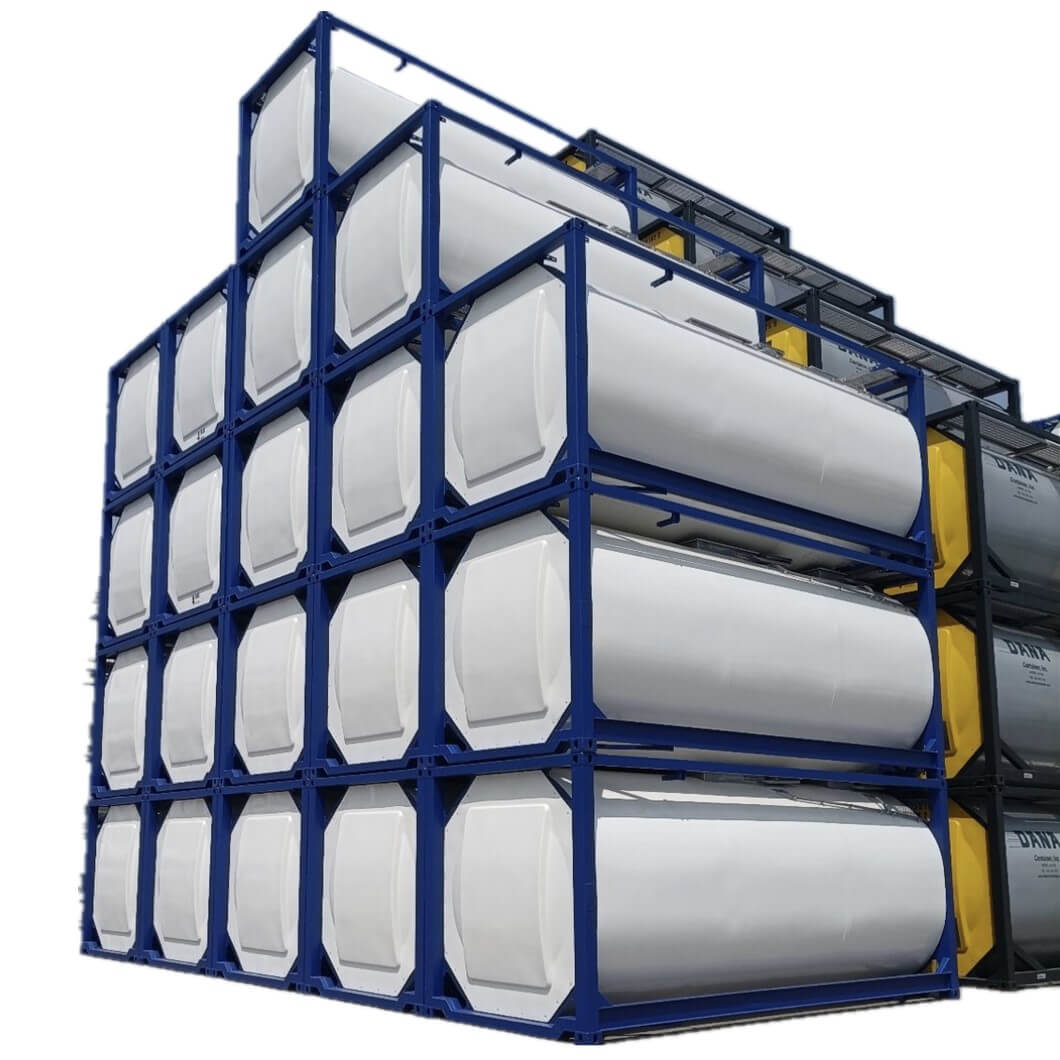
Name | 20ft tank container |
Model | T22/ KSVU |
Medium | Liquid bromine UN1744 |
Volume L | 8320 |
External Dimension Mm | 6058*2438*2438 20' x 8' x 8' |
Tank Size Mm | φ1500*5600 |
Design Pressure Bar | 6.67 |
Test Pressure Bar | 10 |
Design Temperature Range | -40℃~65℃ |
Can Body Material | SA516M Gr485 |
Nominal Shell Thickness Mm | 10.13,12 |
Seal Thickness Mm | 10.13,12 |
Anti Corrosion In Tank | LING LEAD 3-6mm |
Net Weight Of Tank Kg | ≈7800 |
Operation Quality Kg | 36000 |
Max Play Loading Kg | 28200 |
Loading And Unloading Type | Top |
Accessories Configuration | Safety valve+bursting disc * 1, DN65 Gas phase valve * 2, DN40 Liquid phase valve (including siphon and liquid trap) * 1, DN40 Manhole * 1, DN500 |
Design/Manufacturing Standards | IMDG CODE 2016,ADR/RID,49CFR,TIR, |
Third Party Inspection | BV/ ASME /TS |
Attention: | The handling of the containers by using fork lift or similar device is not allowed. Transportation • by truck or freight train using vehicles equipped with approved twist locks which have to be in accordance with the relevant ISO -regulations. • by vessels observing the regulations of stowage, separation and lashing. Special container vessels should be preferred. Attention: In case of transportation by truck or train total weight and dimensions have to be checked and compared with perhaps existing limitations. Unloading Of Bromine from ISO Containers (Three Valve) The ISO containers used for transportation of Bromine are of lead lined. So care shall be taken to ensure that no moisture / atmospheric air enters into the container. |
Keystone Vessel Industrial Gas Cylinders| ISO Tank| Pressure Vessel| UN Portable Tank


