
Views: 2025 Author: Keystone Vessel (Wuhan) Publish Time: 2025-12-31 Origin: Keystone Vessel (Wuhan)
F316L Stainless Steel 24L High-pressure 50 -75MPa Hydrogen H2 GAS Cylinders Test for EU CE
For Semiconductor manufacturing transportation and storage Electronic-Grade Ultra-High Purity Hydrogen, Purity ≥99.9999% H2
High‑pressure hydrogen cylinders 75 MPa CE TPED approved for EU
Marerial :ASTM A182 F316L
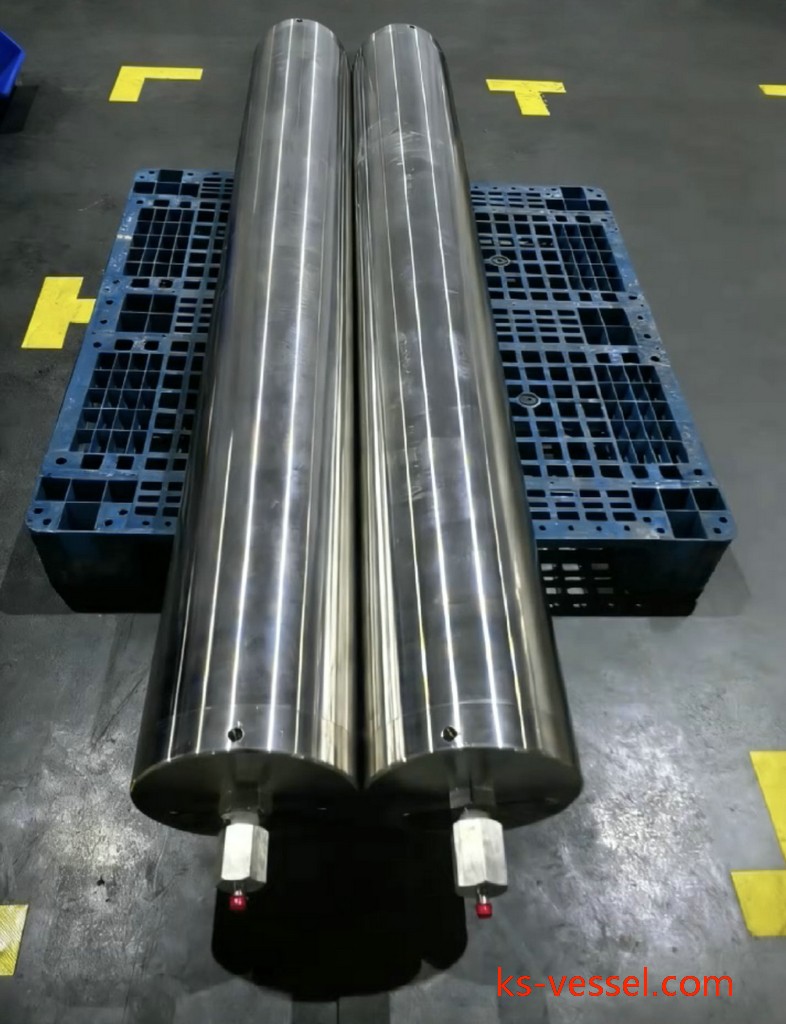
Cylinders Certification: ASME / TS、UN、CE / TPED、DOT
Type IV F316L 24L/50MPa Hydrogen Cylinder Design and Analysis
In-depth Analysis of Design, Technology and Application of Type IV F316L Stainless Steel 24L Ultra-high Pressure Hydrogen Cylinder (Maximum Working Pressure 50MPa)
Core Parameter Definition
This paper focuses on the Type IV composite structure hydrogen cylinder, with the core configuration of "plastic liner + F316L stainless steel bottle mouth/valve seat + full carbon fiber winding reinforcement layer". It has a nominal volume of 24L, a maximum working pressure of 50MPa (the design pressure is adapted to the 50MPa working condition to meet the requirements of long-term safe operation), and a designed pressure test pressure of 75MPa (complying with the industry's general safety factor standard of 1.5 times the working pressure). The medium is high-pressure hydrogen with a purity of ≥99.97%. Combining the structural design principles of hydrogen storage tanks, the core technical characteristics of Type IV cylinders and industry application scenarios, this analysis systematically disassembles their design logic, technical difficulties and application value, providing professional support for product research and development, production and engineering adaptation.
I. Core Design System (Adapting to 24L/50MPa Core Parameters)
The core of the design of the Type IV F316L stainless steel hydrogen cylinder is to balance the four core requirements of "high-pressure bearing, hydrogen barrier, lightweight and safety". Combined with the characteristics of the 24L small and medium volume and the 50MPa working pressure level, the design system is carried out around three dimensions: structural optimization, material adaptation and safety redundancy, and strictly follows the standards such as GB/T 42612-2023 and ISO 15869.
Overall Structural Design (Adapting to 24L Volume and High-pressure Working Conditions)
Adopting the classic layout of Type IV composite structure: plastic liner (gas barrier layer) + F316L stainless steel bottle mouth/valve seat (key part for sealing and bearing) + carbon fiber winding reinforcement layer (main pressure-bearing layer) + outer protective layer (anti-damage layer). The overall design is a cylindrical structure with spherical heads, which effectively reduces stress concentration. The dimensional parameters are optimized for the 24L volume: the inner diameter of the bottle body is designed to be 200mm, the total length is 650mm (including the bottle mouth), the overall weight is controlled at 18-22kg, and the mass hydrogen storage density reaches 6.5-7.0wt%, balancing portability and hydrogen storage efficiency.
Key structural adaptation points: The 24L small and medium volume scenario has high requirements for structural compactness. Therefore, the bottle mouth adopts an integrated design (no welded joints), and the radius of curvature of the head is optimized to 150mm (1.5 times the inner diameter) to avoid local stress concentration; the carbon fiber winding layer adopts a "helical + hoop" hybrid laying method to adapt to the axial and radial stress distribution under the 50MPa working pressure, ensuring structural stability.
Material Selection and Performance Adaptation (Focusing on Compatibility between F316L and High-pressure Hydrogen)
The core logic of material selection is to adapt to the requirements of hydrogen embrittlement resistance, low permeability and high strength in the 50MPa high-pressure hydrogen environment, while matching the lightweight goal of the 24L volume. The performance indicators and parameter adaptability of each core material are as follows:
F316L Stainless Steel (Special Material for Bottle Mouth/Valve Seat)
As the core material of the bottle mouth and valve seat, it is in direct contact with high-pressure hydrogen and undertakes sealing and partial bearing functions. It needs to have excellent hydrogen embrittlement resistance, corrosion resistance and low-temperature performance. The performance indicators are optimized for the 50MPa working condition: tensile strength ≥620MPa, yield strength ≥205MPa, elongation at break ≥40%, ferrite content ≤0.5% (to avoid hydrogen embrittlement caused by stress-induced martensitic transformation), hydrogen environment reduction of area ratio (H₂/He, 230K) ≥0.8. After solution heat treatment (1050-1100℃ water cooling), the processing stress is eliminated, and the surface is electrolytically polished (Ra≤0.2μm) to reduce the hydrogen adsorption and permeation rate.
Adaptability advantage: F316L stainless steel contains Mo element (2-3%), and its hydrogen-induced corrosion resistance is better than that of ordinary stainless steel. It has no performance degradation when used for a long time in a 50MPa high-pressure hydrogen environment. At the same time, it has excellent low-temperature toughness (no brittle fracture at -40℃), adapting to the temperature fluctuation conditions during the hydrogen charging and discharging process of the hydrogen cylinder.
Sealing Material
Perfluoroether O-rings (adapting to the F316L stainless steel sealing surface) are selected, with a service temperature of -40℃~200℃ and a hardness of 70-90Shore A. They have no swelling or leakage in a 50MPa high-pressure hydrogen environment, and the leakage rate is ≤1×10⁻⁷mbar·L/s, ensuring sealing reliability.
Safety Redundancy Design (Matching 50MPa Working Pressure and 75MPa Pressure Test)
The safety design strictly follows the principle of "redundant protection and extreme working condition adaptation". The core safety parameters and protective measures are as follows:
• Pressure safety: The maximum working pressure is 50MPa, the designed pressure test pressure is 75MPa (1.5 times the working pressure, complying with GB/T 150.1 standard), and the burst pressure is ≥112.5MPa (safety factor ≥2.25), ensuring no damage or leakage of the structure after the pressure test;
• Safety accessories: Integrating safety valves (opening pressure 52.5-55MPa, response time ≤2s), rupture discs (burst pressure 55-65MPa), and pressure sensors (accuracy ±0.5%FS), forming triple pressure protection to quickly release pressure under extreme conditions such as overpressure and fire;
• Temperature adaptation: The working temperature range is -40℃~85℃. After low-temperature test (-40℃) and high-temperature test (85℃), there is no leakage or brittle fracture under 50MPa pressure, adapting to different environmental conditions;
• Fatigue life: ≥15,000 pressure cycles (0-50MPa, -40℃~85℃), meeting the requirements of frequent hydrogen charging and discharging scenarios (such as hydrogen refueling stations and on-board hydrogen storage);
• Stress optimization: The stress distribution in the transition area of the bottle mouth and head is optimized through finite element analysis (FEA). Under the 50MPa working pressure, the maximum stress does not exceed 80% of the yield strength of F316L stainless steel, avoiding failure caused by local stress concentration.
II. Key Manufacturing Technologies and Process Control
For the 24L/50MPa/75MPa core parameters, the core of manufacturing technology lies in "precision control, process coordination and quality inspection". It focuses on breaking through key process difficulties such as F316L bottle mouth processing and connection between liner and bottle mouth, ensuring product consistency and reliability.
Disassembly of Core Manufacturing Processes
F316L Stainless Steel Bottle Mouth/Valve Seat Manufacturing Process
Adopting an integrated process of "forging + solution heat treatment + precision machining" to adapt to the 50MPa high-pressure sealing requirements: forging temperature 1100-1200℃, forging ratio ≥3, ensuring uniform internal structure without defects; solution heat treatment (1050-1100℃ water cooling) to eliminate forging stress and improve hydrogen embrittlement resistance; precision machining using CNC machine tools, thread specification M42×2 (adapting to high-pressure valves), sealing groove dimension tolerance ±0.02mm. After machining, the sealing surface is electrolytically polished (Ra≤0.2μm) to ensure sealing fit.
Key control points: Strictly control the temperature gradient during forging to avoid internal stress; the cooling rate after solution heat treatment is controlled above 10℃/min to prevent ferrite precipitation from causing hydrogen embrittlement risk.
Quality Inspection and Test Verification (Focusing on 50MPa/75MPa Core Parameters)
The inspection system covers the whole process of raw materials, semi-finished products and finished products, focusing on special verification for the 50MPa working pressure and 75MPa pressure test pressure to ensure that the products meet safety standards:
• Raw material inspection: Sampling inspection of F316L stainless steel for hydrogen embrittlement sensitivity (no cracks in hydrogen charging test) and mechanical properties; inspection of plastic liner for hydrogen permeability and low-temperature impact strength; inspection of carbon fiber for tensile strength and elastic modulus. Only 100% qualified products can be put into use;
• Semi-finished product inspection: Liner dimension inspection (wall thickness, inner diameter tolerance), bottle mouth sealing surface roughness inspection; tensile test and air tightness test of the connection part;
• Finished product core inspection:
○ Pressure test: Water pressure test pressure 75MPa, holding time 30min, no leakage, deformation or rupture (meeting the designed pressure test requirements);
○ Air tightness test: Holding pressure at 50MPa for 60min, leakage rate ≤1×10⁻⁷mbar·L/s;
○ Burst test: Sampling ratio ≥3%, burst pressure ≥112.5MPa, no fragment splashing after burst;
○ Fatigue life test: 15,000 pressure cycles (0-50MPa, -40℃~85℃), no leakage or cracks after the test;
○ Low-temperature/high-temperature test: After holding at -40℃/85℃ for 2h, the air tightness is qualified under 50MPa pressure.
III. Application Scenario Adaptation and Market Value Analysis
With the core advantages of small and medium volume, high-pressure adaptation, lightweight and high safety redundancy, the Type IV F316L stainless steel 24L/50MPa ultra-high pressure hydrogen cylinder is suitable for diversified hydrogen energy application scenarios. It has significant competitiveness especially in fields requiring frequent hydrogen charging and discharging and high portability, and is in line with the large-scale development trend of the hydrogen energy industry.
Core Application Scenario Adaptation (Ranked by Priority)
Fuel Cell Vehicle (FCV) Auxiliary Hydrogen Storage/Commercial Vehicle Adaptation
Adaptable scenarios: On-board hydrogen storage systems for fuel cell logistics vehicles and light commercial vehicles (range 400-600km), or auxiliary hydrogen storage cylinders for passenger cars; also can be used for on-board hydrogen storage of hydrogen fuel forklifts (indoor operation with high safety requirements).
Adaptation advantages: The 24L volume corresponds to a hydrogen storage capacity of about 1.5-1.8kg H₂, meeting the short-distance transportation needs of light commercial vehicles; the 50MPa working pressure adapts to the hydrogen charging needs of mainstream hydrogen refueling stations (35/70MPa), and can be compatible with pressure-reduced hydrogen charging at 70MPa hydrogen refueling stations; the F316L stainless steel bottle mouth has hydrogen embrittlement resistance and corrosion resistance, adapting to frequent hydrogen charging and discharging conditions (hydrogen charging and discharging ≤8 times per day); the overall weight is 18-22kg, with significant lightweight advantages, reducing vehicle energy consumption.
Market prospect: With the large-scale promotion of domestic fuel cell commercial vehicles (the planned ownership exceeds 100,000 by 2025), the demand for small and medium volume high-pressure hydrogen cylinders will continue to grow. This model can be used as one of the core adaptation solutions.
Hydrogen Refueling Station Buffer Hydrogen Storage/Emergency Hydrogen Storage
Adaptable scenarios: Buffer hydrogen storage cylinder groups of hydrogen refueling stations (35/70MPa) (regulating hydrogen charging pressure fluctuations), emergency hydrogen storage cylinders (temporary supply in case of sudden supply interruption); also can be used for internal buffer hydrogen storage of hydrogen dispensers.
Adaptation advantages: The 50MPa working pressure adapts to the high-pressure working conditions of hydrogen refueling stations, and the 75MPa pressure test pressure ensures structural safety redundancy; the 24L small and medium volume is convenient for flexible combination (the cylinder group can be matched with volume on demand), adapting to the needs of hydrogen refueling stations of different scales; F316L stainless steel has good compatibility with high-pressure hydrogen, low long-term use and maintenance costs, and meets the durability requirements of frequent hydrogen charging and discharging (10-15 times per day) at hydrogen refueling stations.
Policy alignment: The national "Medium and Long-term Plan for the Development of the Hydrogen Energy Industry" clearly requires strengthening the safety guarantee of hydrogen storage equipment at hydrogen refueling stations. The high safety redundancy design of this model is in line with the policy orientation.
Distributed Energy Storage and Portable Hydrogen Energy Equipment
Adaptable scenarios: Distributed hydrogen production and storage systems for renewable energy such as wind power and photovoltaic (small energy storage stations, hydrogen storage demand 5-10kg); portable hydrogen energy power generation equipment (outdoor operations, emergency power supply); small hydrogen fuel cell backup power supplies.
Adaptation advantages: The 24L volume has strong portability and can be flexibly arranged in distributed energy storage stations; the 50MPa high-pressure hydrogen storage density is high, reducing the floor area; the combination of F316L stainless steel and plastic liner has no hydrogen embrittlement risk, a service life of ≥20 years, and reduces the long-term maintenance cost of the energy storage system; it can be compatible with the high-pressure output of hydrogen production equipment (electrolyzers) without additional boosting equipment.
High-end Industrial and Scientific Research Scenarios
Adaptable scenarios: Semiconductor manufacturing (transportation and storage of electronic-grade ultra-high purity hydrogen, purity ≥99.9999%), laboratory high-pressure hydrogen test equipment, small-scale high-pressure hydrogen storage for industrial gases (hydrogen for special processes).
Adaptation advantages: F316L stainless steel has low pollution and corrosion resistance, avoiding hydrogen gas impurity pollution; the plastic liner has low hydrogen permeability, ensuring that the purity of ultra-high purity hydrogen does not degrade during storage; the 24L small and medium volume adapts to the hydrogen demand of laboratory and small-scale industrial equipment, with strong flexibility.
Application Advantages and Comparison with Competitors (vs Type III Cylinders/Traditional Metal Cylinders)
Comparison Dimension | Model (Type IV F316L/24L/50MPa) | Type III Cylinders (Aluminum Alloy Liner/24L/50MPa) | Traditional Metal Cylinders (Stainless Steel/24L/50MPa) |
Mass Hydrogen Storage Density | 6.5-7.0wt% | 5.8-6.2wt% | 3.0-3.5wt% |
Overall Weight (24L) | 18-22kg | 25-28kg | 45-50kg |
Hydrogen Embrittlement Resistance | Excellent (F316L + plastic liner, no hydrogen embrittlement risk) | Good (aluminum alloy has general hydrogen embrittlement resistance, requiring regular inspection) | General (high risk of metal hydrogen embrittlement) |
Fatigue Life (times) | ≥15,000 | ≥10,000 | ≥5,000 |
Maintenance Cost | Low (long service life, low frequency of hydrogen embrittlement inspection) | Medium (regular hydrogen embrittlement inspection required) | High (easy to corrode, high inspection frequency) |
Adaptable Scenarios | On-board, hydrogen refueling stations, distributed energy storage, scientific research | On-board, fixed hydrogen storage | Low-end industrial hydrogen storage, temporary hydrogen storage |
Market Value and Development Prospect
At present, the hydrogen energy industry is in a stage of rapid large-scale development. As a core equipment, high-pressure hydrogen storage cylinders have a continuously expanding market demand. This Type IV F316L stainless steel 24L/50MPa hydrogen cylinder accurately adapts to the scenarios with small and medium volume, high-pressure and high-safety requirements. Its market value is mainly reflected in three aspects: first, it fills the gap in the segmented market of small and medium volume Type IV high-pressure hydrogen cylinders, adapting to emerging scenarios such as light commercial vehicles and distributed energy storage; second, the high safety of F316L stainless steel materials is in line with the development principle of "safety first" for hydrogen energy equipment, enhancing product competitiveness; third, with the localization of carbon fiber and plastic liner materials (such as the cost reduction of T700 grade carbon fiber), the cost of the product is expected to decrease by 20-30% after large-scale production, further expanding the market application scope.
Long-term prospect: It is expected that from 2025 to 2030, the market size of domestic small and medium volume (10-50L) high-pressure hydrogen storage cylinders will grow at a compound annual growth rate of more than 35%. With its performance and scenario adaptation advantages, this model is expected to occupy an important market share in fields such as on-board auxiliary hydrogen storage, hydrogen refueling station buffer hydrogen storage and distributed energy storage, providing core equipment support for the diversified application of the hydrogen energy industry.
IV. Core Challenges and Technical Optimization Directions
Although this model of hydrogen cylinder has significant performance and scenario advantages, it still faces three core challenges in the process of large-scale production and application: cost control, process optimization and extreme working condition adaptation. The corresponding technical optimization directions are as follows:
Core Challenges
• Cost control: The cost of carbon fiber materials accounts for more than 60% of the total product cost. The precision machining cost of F316L stainless steel is high, and the economies of scale of 24L small and medium volume products are insufficient, resulting in high unit cost;
• Process consistency: The fiber tension control in the winding process and the consistency of the bonding strength between the liner and the bottle mouth have a great impact on product performance, and fluctuations are prone to occur in large-scale production;
• Extreme working condition adaptation: The sealing performance and durability of the connection part between the plastic liner and F316L stainless steel under low temperature below -40℃ and high humidity environment still need further verification.
Technical Optimization Directions
• Cost optimization: Adopt integrated forging + automated processing for the F316L stainless steel bottle mouth to improve production efficiency and reduce processing costs; optimize the overall molding process to reduce material waste and improve the efficiency of large-scale production;
• Process optimization: Optimize the molding encapsulation process parameters, adopt automated injection molding equipment to improve the consistency of the connection between the liner and the bottle mouth; strengthen the precision control of each process to ensure the stability of product performance;
• Extreme working condition adaptation: Develop EVOH/HDPE composite liner materials to improve low-temperature toughness; add a nano-coating (such as Al₂O₃) to the F316L stainless steel sealing surface to improve corrosion resistance in high humidity environments; carry out low-temperature cycle tests at -60℃ to optimize the sealing structure design.
V. Conclusion
The Type IV F316L stainless steel 24L ultra-high pressure hydrogen cylinder (maximum working pressure 50MPa, designed pressure test pressure 75MPa) takes the composite structure of "plastic liner + F316L stainless steel bottle mouth + carbon fiber winding" as the core, accurately matching the small and medium volume, high-pressure and high-safety hydrogen storage requirements. It has core advantages such as high mass hydrogen storage density, excellent hydrogen embrittlement resistance and wide adaptation scenarios, and can effectively serve diversified scenarios such as fuel cell commercial vehicles, hydrogen refueling stations, distributed energy storage and high-end industry.
At the technical level, through optimizing structural design, strict material selection and precise process control, the product realizes the safe adaptation of 50MPa working pressure and 75MPa pressure test pressure, and its core performance is better than that of Type III cylinders and traditional metal cylinders; at the market level, the product is in line with the large-scale development trend of the hydrogen energy industry, fills the gap in the segmented market of small and medium volume Type IV high-pressure hydrogen cylinders, and has significant market value and development prospect. In the future, by continuously optimizing cost control and process consistency and improving the adaptability to extreme working conditions, this model is expected to become the core mainstream solution in the field of small and medium volume high-pressure hydrogen storage, providing important support for the safe and efficient development of the hydrogen energy industry.
Keystone Vessel Specializing - Industrial Gas Cylinders| ISO Tank| Pressure Vessel| UN Portable Tank


