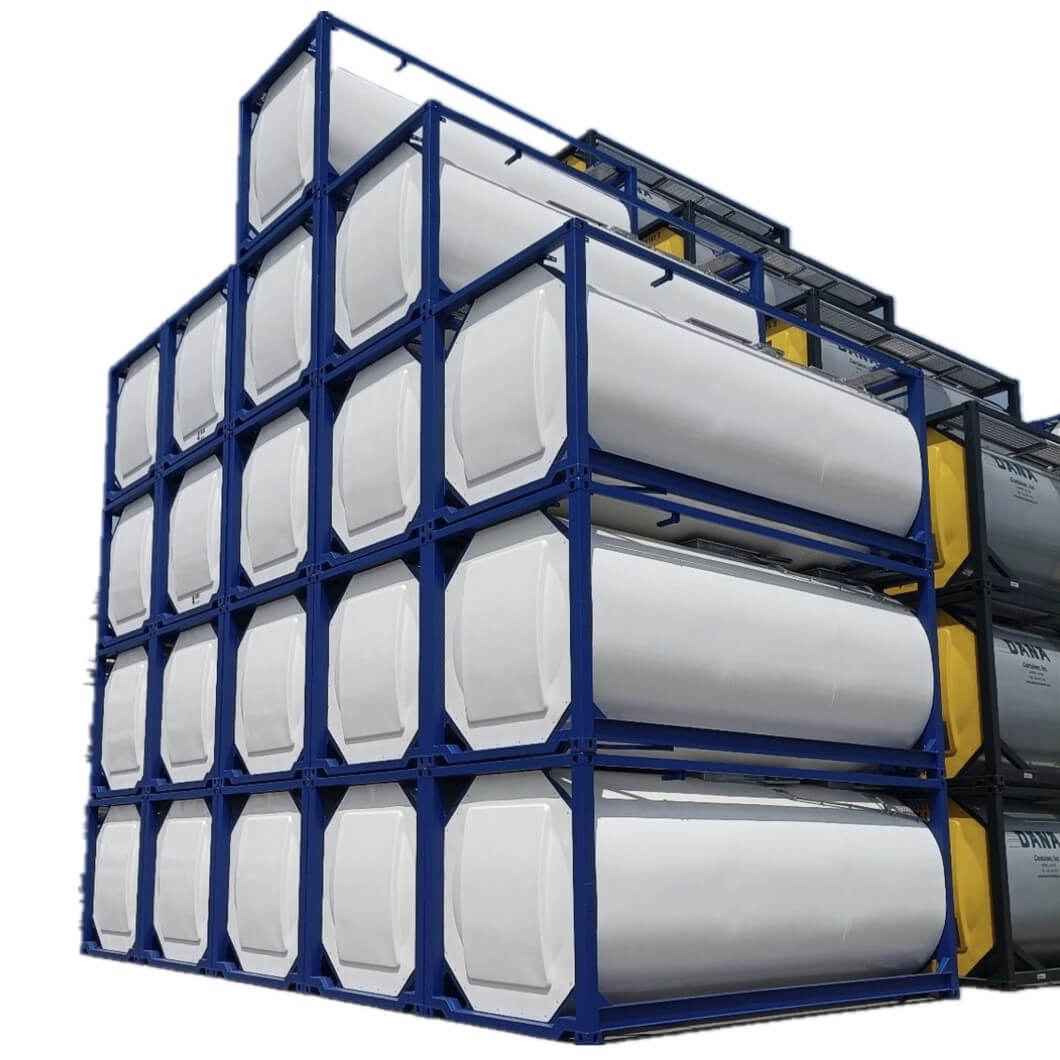
T22 ISO Tank Container (highest-hazard organometallics, fluorinations) Instruction
T22 portable tanks ride 10 bar test, 10 mm reference-steel shell (6.96 mm 316L), no bottom outlet, frangible disc. ASME U-stamp mandatory under 49 CFR 178.275. The heaviest commercial standard for organometallics, fluorination products, Hazard Zone A/B toxics.
T20 and T22 ISO Tanks:
In liquid logistics, using the right tank type is crucial for safe, compliant, and cost-effective transportation. While T11 and T14 ISO tanks are common choices, T20 and T22 tanks serve specialized roles for hazardous and pressurized cargoes often overlooked in standard shipments.
This article explores the unique specifications, applications, and advantages of T20 and T22 tanks in the global supply chain.
A T20 ISO tank is a high-pressure, portable tank container designed specifically for transporting highly hazardous pressurized liquids and liquefied gases. These tanks are built to comply with stringent international standards and certified under ASME U2 for unfired pressure vessels.
Key Specifications:
– Working Pressure: Approximately 6.67 bar (97 psi)
– Test Pressure: Up to 10 bar (145 psi)
– Shell Thickness: Minimum 8 mm
– Capacity: Typically, available in 14,500 to 21,000 liters
Typical Cargo: – Highly hazardous pressurized chemicals
– Toxic liquids needing reinforced containment
– Pressurized gases and liquefied gases compatible with the tank linings
Real-world Usage:
T20 tanks are commonly used for high-risk chemicals and pressurized liquids such as titanium tetrachloride and other toxic intermediates where standard lower-pressure tanks do not provide sufficient safety.
The T22 ISO tank offers enhanced safety features over the T20 variant, including thicker shells and specialized linings for extreme corrosive or toxic liquid cargoes. It is suitable for substances requiring higher containment strength and temperature control.
Key Specifications:
– Working Pressure: Approximately 6.67 bar to 10 bar (97 to 145 psi)
– Test Pressure: Up to 10 bar (145 psi)
– Shell Thickness: Minimum 10 mm
– Capacity: Similar 14,500 to 21,000 liters range, depending on configuration
– Optional Linings: PTFE, rubber, and marine-grade stainless steel cladding for chemical resistance
Typical Cargo:
– Corrosive acids like acetic acid
– Toxic or heat-sensitive chemicals
– Highly reactive or pressurized substances needing specialized tank linings and insulation
Real-world Usage:
T22 tanks are frequently chosen for corrosive or toxic cargoes that require stronger containment and safety measures but do not demand the highest T14 tank specifications.
T20 vs T22 – A Clear Comparison
| Feature | T20 Tank | T22 Tank |
| Working Pressure | ~6.67 bar (97 psi) | ~6.67 – 10 bar (97–145 psi) |
| Test Pressure | Up to 10 bar (145 psi) | Up to 10 bar (145 psi) |
| Shell Thickness | Minimum 8 mm | Minimum 10 mm |
| Cargo Examples | Toxic pressurized liquids, gases | Corrosive acids, toxic, and heat-sensitive liquids |
| Safety Level | High (ASME U2 certified) | Higher with specialized linings and insulation |
| Usage Frequency | Specialized hazardous cargo | Specialized for more aggressive chemicals |
Lead-lined T22 ISO Tank Containers specialized for the safe storage and transportation of Br2 Bromine liquid (UN No. 1744). The company manufactures ISO tank containers in full compliance with internationally recognized standards and certifications, including ASME Section VIII Division 1, ISO (T22), IMDG T22, CSC, RID/ADR, US DOT (CFR 49), TIR, TC, and UIC.
Technical Specifications:
Size Available:10ft, 20ft ISO tank container.
Dimensions (L x W x H): 6058 mm x 2438 mm x 2438 mm.
Capacity: 8200 Liters.
Design Code: ASME Section VIII div-1.
Material of Construction (MOC): Carbon Steel (Tank).
Tare Weight: 7000 kgs.
Temperature: -40 to 65 deg C.
Operating Pressure: 6.6 Bar.
Test Pressure: 10 Bar.
The ISO tank containers are equipped with a lead-lined internal liner, specifically engineered to ensure chemical compatibility, corrosion resistance, and long-term safety for bromine service during storage and global transportation.
Benefits of T20 and T22 Tanks
✔ Precisely designed for high-pressure, hazardous cargos requiring robust containment and specialized linings
✔ Compliance with international codes including IMDG, ADR, ASME U2, and ISO standards
✔ Enhanced safety features such as pressure relief valves, steam heating systems, baffles, and spill boxes
✔ Cost-effective alternatives to over-specification when T14 tanks are not needed
Why Choose T20 or T22 Over T11 or T14 Tanks?
– Compared to T11: T11 tanks are versatile but intended for lower-pressure or non-pressurized hazardous liquids. T20 and T22 offer higher pressure ratings and are built for truly hazardous pressurized cargo that T11 cannot safely contain.
– Compared to T14: T14 tanks are designed for very high-pressure and temperature cargoes. When cargoes are hazardous and pressurized but not extreme, T22 tanks provide a compliant, economical option with sufficient containment strength and chemical resistance.
T14 ,T20 ,T21,T22, UN IMDG list:
| UN No. | Proper Shipping Name | Packing instruction | Tank instruction | Properties and observations |
| 1383 | Pyrophoric metals, n.o.s. or pyrophoric alloys, n.o.s. | P404 | T21 | Readily ignites spontaneously in air. Shaking produces sparks. In contact with water gives off flammable hydrogen gas. |
| 1854 | Barium alloys, pyrophoric | P404 | T21 | Readily self-ignites in air. Shaking produces sparks. In contact with water, gives off flammable hydrogen gas. |
| 2008 | Zirconium powder, dry | P404 | T21 | Amorphous powder. Readily self-igniting in air. Forms explosive mixtures with oxidizing substances. |
| 2447 | Phosphorus, white, molten | - | T21 | Molten liquid. Melting point: 44°C. Self-ignites in air. Toxic by swallowing, by skin contact or by inhalation. Carried in the molten state at temperatures above its melting point. |
| 2870 | Aluminium borohydride | P400 | T21 | Liquid. Self-ignites in air. Reacts with water or vapour, producing heat or hydrogen gas which may form explosive mixtures with air. |
| 2881 | Metal catalyst, dry | P404 | T21 | Readily self-ignites in air. |
| 3200 | Pyrophoric solid, inorganic, n.o.s. | P404 | T21 | Readily self-ignites in air. Shaking may produce sparks. In contact with water gives off hydrogen gas. |
| 3254 | Tributylphosphane | P400 | T21 | Colourless to pale yellow liquid, insoluble in water. Concentrated garlic-smelling gas (phosphine). Readily generates heat and self-ignites in air. In a fire produces phosphine, a flammable highly toxic gas. Reacts violently with oxidizing substances (peroxides, halogens, nitrogen oxides and carbon tetrachloride). Irritates mucous membranes. |
| 3391 | Organometallic substance, solid, pyrophoric | P404 | T21 | Readily self-ignites in air. Shaking may produce sparks. |
| 3392 | Organometallic substance, liquid, pyrophoric | P400 | T21 | Highly flammable liquid. Readily self-ignites in air. In contact with air, gives off irritating, slightly toxic fumes. |
| 3393 | Organometallic substance, solid, pyrophoric, water-reactive | P404 | T21 | Readily self-ignites in air; shaking may produce sparks. Reacts violently with moisture, water and acids giving off flammable gas. |
| 3394 | Organometallic substance, water-reactive, liquid, pyrophoric | P400 | T21 | Highly flammable liquid. Readily self-ignites in air. In contact with air, gives off irritating, slightly toxic fumes. Reacts violently with moisture, water and acids giving off flammable gas. |
3381 | Inhalation toxic liquid, n.o.s., with an LC50 less than or equal to 200 mL/m3 and saturated vapour concentration greater than or equal to 500 LC50 | P601 | T22 | Various toxic liquids presenting a high risk of poisoning by inhalation. Severely toxic by inhalation, by swallowing or by skin contact. |
3382 | Inhalation toxic liquid, n.o.s., with an LC50 less than or equal to 1000 mL/m3 and saturated vapour concentration greater than or equal to 10 LC50 | P602 | T20,T21,T22 | Various toxic liquids presenting a high risk of poisoning by inhalation. Severely toxic by inhalation, by swallowing or by skin contact. |
3383 | Inhalation toxic liquid, flammable, n.o.s., with an LC50 less than or equal to 200 mL/m3 and saturated vapour concentration greater than or equal to 500 LC50 | P601 | T22 | Various toxic liquids presenting a high risk of poisoning by inhalation, and flammable. Severely toxic by inhalation, by swallowing or by skin contact. |
3384 | Inhalation toxic liquid, flammable, n.o.s., with an LC50 less than or equal to 1000 mL/m3 and saturated vapour concentration greater than or equal to 10 LC50 | P602 | T20,T21,T22 | Various toxic liquids presenting a high risk of poisoning by inhalation, and flammable. Severely toxic by inhalation, by swallowing or by skin contact. |
3385 | Inhalation toxic liquid, water-reactive, n.o.s., with an LC50 less than or equal to 200 mL/m3 and saturated vapour concentration greater than or equal to 500 LC50 | P601 | T22 | Various toxic liquids presenting a high risk of poisoning by inhalation, and which react with water. Severely toxic by inhalation, by swallowing or by skin contact. |
3386 | Inhalation toxic liquid, water-reactive, n.o.s., with an LC50 less than or equal to 1000 mL/m3 and saturated vapour concentration greater than or equal to 10 LC50 | P602 | T20,T21,T22 | Various toxic liquids presenting a high risk of poisoning by inhalation, and which react with water. Severely toxic by inhalation, by swallowing or by skin contact. |
3387 | Inhalation toxic liquid, oxidizing, n.o.s., with an LC50 less than or equal to 200 mL/m3 and saturated vapour concentration greater than or equal to 500 LC50 | P601 | T22 | Various toxic liquids presenting a high risk of poisoning by inhalation, and oxidizing. Severely toxic by inhalation, by swallowing or by skin contact. |
3388 | Inhalation toxic liquid, oxidizing, n.o.s., with an LC50 less than or equal to 1000 mL/m3 and saturated vapour concentration greater than or equal to 10 LC50 | P602 | T20,T21,T22 | Various toxic liquids presenting a high risk of poisoning by inhalation, and oxidizing. Severely toxic by inhalation, by swallowing or by skin contact. |
3389 | Inhalation toxic liquid, corrosive, n.o.s., with an LC50 less than or equal to 200 mL/m3 and saturated vapour concentration greater than or equal to 500 LC50 | P601 | T22 | See the entry above. |
3390 | Inhalation toxic liquid, corrosive, n.o.s., with an LC50 less than or equal to 1000 mL/m3 and saturated vapour concentration greater than or equal to 10 LC50 | P602 | T20,T21,T22 | Various toxic liquids presenting a high risk of poisoning by inhalation, and corrosive. Severely toxic by inhalation, by swallowing or by skin contact. |
3391 | Organometallic substance, solid, pyrophoric | P404 | T21 | Readily self-ignites in air. Shaking may produce sparks. |
3392 | Organometallic substance, liquid, pyrophoric | P400 | T21 | Highly flammable liquid. Readily self-ignites in air. In contact with air, gives off irritating, slightly toxic fumes. |
3393 | Organometallic substance, solid, pyrophoric, water-reactive | P404 | T21 | Readily self-ignites in air; shaking may produce sparks. Reacts violently with moisture, water and acids giving off flammable gas. |
3394 | Organometallic substance, water-reactive, liquid, pyrophoric | P400 | T21 | Highly flammable liquid. Readily self-ignites in air. In contact with air, gives off irritating, slightly toxic fumes. Reacts violently with moisture, water and acids giving off flammable gas. |
3395 | Organometallic substance, solid, water-reactive | P410 | T20,T21,T22 | Reacts violently with moisture, water and acids giving off flammable gas. |
3395 | Organometallic substance, solid, water-reactive | P403 | T20,T21,T22 | Reacts violently with moisture, water and acids giving off flammable gas. |
3396 | Organometallic substance, solid, water-reactive, flammable | P410 | T20,T21,T22 | Flammable solid. Reacts violently with moisture, water and acids, giving off flammable gas. |
3396 | Organometallic substance, solid, water-reactive, flammable | P403 | T20,T21,T22 | Flammable solid. Reacts violently with moisture, water and acids, giving off flammable gas. |
3397 | Organometallic substance, solid, water-reactive, self-heating | P403 | T20,T21,T22 | Readily self-heating or self-igniting. Reacts violently with moisture, water and acids giving off flammable gas. |
3397 | Organometallic substance, solid, water-reactive, self-heating | P410 | T20,T21,T22 | Readily self-heating or self-igniting. Reacts violently with moisture, water and acids giving off flammable gas. |
3398 | Organometallic substance, liquid, water-reactive | P001 | T20,T21,T22 | Reacts violently with moisture, water and acids giving off flammable gas. |
3398 | Organometallic substance, liquid, water-reactive | P402 | T14 ,T20,T21,T22 | Reacts violently with moisture, water and acids giving off flammable gas. |
3398 | Organometallic substance, liquid, water-reactive | P001 | T20,T21,T22 | Reacts violently with moisture, water and acids giving off flammable gas. |
3399 | Organometallic substance, water-reactive, flammable | P001 | T20,T21,T22 | Flammable liquid. Reacts violently with moisture, water and acids, giving off flammable gas. |
3399 | Organometallic substance, water-reactive, flammable | P402 | T14 ,T20,T21,T22 | Flammable liquid. Reacts violently with moisture, water and acids, giving off flammable gas. |
3399 | Organometallic substance, water-reactive, flammable | P001 | T20,T21,T22 | Flammable liquid. Reacts violently with moisture, water and acids, giving off flammable gas. |
Final Thoughts
While T11 and T14 tanks dominate liquid bulk logistics, T20 and T22 ISO tanks specialize in safely transporting highly hazardous, pressurized, and corrosive chemicals with enhanced safety and compliance. Choosing the right tank depends on balancing safety, cargo-specific requirements, and cost-effectiveness — a choice ARCON prioritizes to deliver trust and reliability in every shipment.
T22 IMDG UN List:
| UN No. | Proper Shipping Name | Packing instruction | Tank instruction | Properties and observations |
| 1092 | Acrolein, stabilized | P601 | T22 | Colourless or yellow liquid with a strong pungent odour. Flash point: -26°C c.c. Explosive limits: 2.8% to 31%. Boiling point: 52°C. Miscible with water. Severely toxic by swallowing, by skin contact or by inhalation. |
| 1185 | Ethyleneimine, stabilized | P601 | T22 | Colourless oily flammable liquid with a pungent ammonia-like odour. Flash point: -13°C c.c. Boiling point: 55°C. Explosive limits: 3.6% to 6.0%. Miscible with water. Severely toxic by swallowing, by skin contact or by inhalation. |
| 1238 | Methyl chloroformate | P602 | T22 | Colourless liquid. Flash point: 5°C c.c. Not miscible with water. Severely toxic by swallowing, by skin contact or by inhalation. Burns skin, eyes and mucous membranes. |
| 1239 | Methyl chloromethyl ether | P602 | T22 | Colourless liquid. Flash point: below -18°C c.c. Not miscible with water. Severely toxic by swallowing, by skin contact or by inhalation. |
| 1244 | Methylhydrazine | P602 | T22 | Colourless liquid with an ammonia-like odour. Flash point: 20°C c.c. Explosive limits: 2.5% to 98%. Miscible with water. May react dangerously with oxidizing agents. Severely toxic by swallowing, by skin contact or by inhalation. Burns skin, eyes and mucous membranes. Reacts violently with acids. |
| 1251 | Methyl vinyl ketone, stabilized | P601 | T22 | Colourless flammable liquid with a pungent odour. Miscible with water. Explosive limits: 2.1% to 15.6%. Flash point: -7°C c.c. Severely toxic by swallowing, by skin contact or by inhalation. Burns skin, eyes and mucous membranes. |
| 1580 | Chloropicrin | P601 | T22 | Colourless oily liquid. Severely toxic by swallowing, by skin contact or by inhalation. |
| 1744 | Bromine or bromine solutions | P804 | T22 | Dark brown heavy liquid with a strong pungent odour. Density: 3.1 (pure). Boiling point: 59°C. Strong oxidizer; ignites in contact with organic substances such as wood, cotton or grass. Strongly corrosive to most metals. Solutions have the same characteristics as the lower-concentration solutions depending on their concentration. Toxic by swallowing, by skin contact or by inhalation. Burns skin, eyes and mucous membranes. |
| 1745 | Bromine pentafluoride | P200 | T22 | Colourless heavy liquid with an extremely pungent odour. Boiling point: 40°C. Strong oxidizer, ignites in contact with organic substances such as wood, cotton or grass. Reacts violently with water, giving off white fumes of toxic and strongly corrosive hydrogen fluoride gas. In contact with acids or acid fumes gives off highly toxic fumes of bromine, fluorine and their compounds. Strongly corrosive to most metals. Toxic by swallowing, by skin contact or by inhalation of vapour. Burns skin, eyes and mucous membranes. |
| 1746 | Bromine trifluoride | P200 | T22 | Colourless heavy liquid with an extremely pungent odour. Strong oxidizer; ignites in contact with organic substances such as wood, cotton or grass. Reacts violently with water, giving off white fumes of toxic strongly corrosive hydrogen fluoride gas. In contact with acids or acid fumes gives off highly toxic fumes of bromine, fluorine and their compounds. Strongly corrosive to most metals. Toxic by swallowing, by skin contact or by inhalation. Burns skin, eyes and mucous membranes. |
| 1994 | Iron pentacarbonyl | P601 | T22 | Yellow to dark red, volatile flammable liquid. Flash point: -15°C c.c. Explosive limits: 3.7% to 12.5%. Reacts with water or water vapour, giving off toxic carbon monoxide gas. Severely toxic by swallowing, by skin contact or by inhalation. |
| 2480 | Methyl isocyanate | P601 | T22 | Flammable liquid with a pungent odour. Flash point: -7°C c.c (pure substance). Boiling point: 38°C (pure substance). Vapour heavier than air. Not miscible with water, but reacts violently with water. In contact with water or acids gives off highly toxic nitrous acid fumes. Severely toxic by swallowing, by skin contact or by inhalation. Irritating to skin, eyes and mucous membranes. |
| 2845 | Pyrophoric liquid, organic, n.o.s. | P400 | T22 | Highly flammable liquid, may self-ignite in moist air. In contact with air gives off irritating and slightly toxic fumes. |
| 3381 | Inhalation toxic liquid, n.o.s., with an LC50 less than or equal to 200 mL/m3 and saturated vapour concentration greater than or equal to 500 LC50 | P601 | T22 | Various toxic liquids presenting a high risk of poisoning by inhalation. Severely toxic by inhalation, by swallowing or by skin contact. |
| 3383 | Inhalation toxic liquid, flammable, n.o.s., with an LC50 less than or equal to 200 mL/m3 and saturated vapour concentration greater than or equal to 500 LC50 | P601 | T22 | Various toxic liquids presenting a high risk of poisoning by inhalation, and flammable. Severely toxic by inhalation, by swallowing or by skin contact. |
| 3385 | Inhalation toxic liquid, water-reactive, n.o.s., with an LC50 less than or equal to 200 mL/m3 and saturated vapour concentration greater than or equal to 500 LC50 | P601 | T22 | Various toxic liquids presenting a high risk of poisoning by inhalation, and which react with water. Severely toxic by inhalation, by swallowing or by skin contact. |
| 3387 | Inhalation toxic liquid, oxidizing, n.o.s., with an LC50 less than or equal to 200 mL/m3 and saturated vapour concentration greater than or equal to 500 LC50 | P601 | T22 | Various toxic liquids presenting a high risk of poisoning by inhalation, and oxidizing. Severely toxic by inhalation, by swallowing or by skin contact. |
| 3389 | Inhalation toxic liquid, corrosive, n.o.s., with an LC50 less than or equal to 200 mL/m3 and saturated vapour concentration greater than or equal to 500 LC50 | P601 | T22 | See the entry above. |
| 3488 | Inhalation toxic liquid, flammable, corrosive, n.o.s., with an LC50 less than or equal to 200 mL/m3 and saturated vapour concentration greater than or equal to 500 LC50 | P601 | T22 | Various toxic liquids of high inhalation toxicity, also flammable and corrosive. Severely toxic by swallowing, by skin contact or by inhalation. Burn skin, eyes and mucous membranes. |
| 3490 | Inhalation toxic liquid, water-reactive, flammable, n.o.s., with an LC50 less than or equal to 200 mL/m3 and saturated vapour concentration greater than or equal to 500 LC50 | P601 | T22 | Various toxic liquids of high inhalation toxicity, also with water-reaction and flammable hazards. Severely toxic by swallowing, by skin contact or by inhalation. |
Market participants
Manufacturers
CIMC
Eurotainer
Keystone Vesse