
Views: 2025 Author: Keystone Vessel (Wuhan) Publish Time: 2025-06-10 Origin: Keystone Vessel (Wuhan)
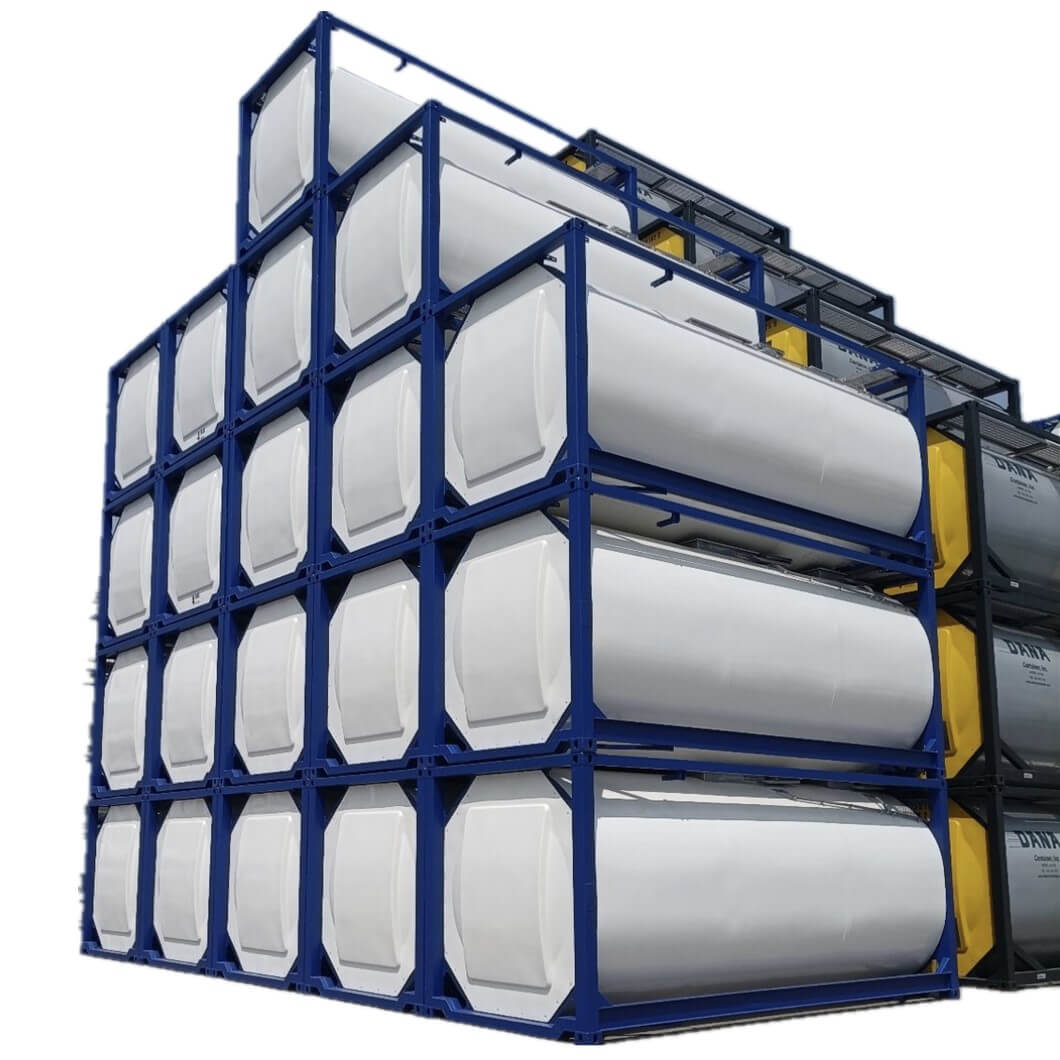
50 PCS T21 C-480 Catalyst MAO Toluene Solution Cylinders UN3399 Portable Tanks

UN PORTABLE TANK T21 designed for the shipment of metal alkyls and organometallic specialties. Our shipping containers are designed and constructed to meet all national and international transport regulations and are tested periodically, in accordance with the appropriate regulations.
Polypropylene catalyst Tank Cylinder
Polyethylene catalyst Tank Cylinder
Acrylonitrile catalyst Tank
Triethyl aluminium Tank Cylinder
Titanium tetrachloride Tank Cylinder
Polypropylene resin Tank Cylinder
Antioxidants Tank Cylinder
Modified engineering plastics Tank Cylinder
Battery diaphragm Tank Cylinder
Polyether polyol Tank Cylinder
| Cylinder | Volume (90% full) | Dimensions Diameter | Height |
| Pyrosafe | 0.85 L (0.225 gal) | 9.0 cm (3.562 in) | 26.7 cm (10.5 in) |
| C-2 | 9.8 L (2.59 gal) | 23.2 cm (9.125 in) | 46.4 cm (18.25 in) |
| C-5 | 19.6 L (5.18 gal) | 30.8 cm (12.125 in) | 53.3 cm (21 in) |
| C-28 | 98.4 L(26.0 gal) | 37.1 cm (14.625 in) | 129.5 cm (51 in) |
| C-118 | 405 L (107 gal) | 76.2 cm (30.0 in) | 145.7 cm (57.4 in) |
| Portable tank | Volume (90% full) | Dimensions Length | Diameter | Height |
| C-250 | 829L (219 gal) | 208 cm (82 in) | 81 cm (32 in) | 96.5 cm (38 in) |
| C-430 | 1,465L | 208 cm | 107 cm | 122 cm |
| type | (432 gal) | (82 in) | (42 in) | (48 in) |
| C-480 saddle 1,880L | 1692L | 208 cm | 107 cm | 128 cm |
| type | (387 gal) | (82 in) | (42 in) | (50.5 in) |
| C-1980 7490L | 6,741 L (1,782 gal) | 305 cm (120 in) | 190 cm (74.8 in) | 224 cm (88.2 in) |
| ISO 20FT Container | 19,200-21,150 l (5,068-5,584 gal) | 606 cm (239 in) | 244 cm (96 in) | 259 cm (102 in) |
UN3394 Storage TEAL TMA TIBAL Metal Alkyls T21 UN Portable Tanks
UN3394/UN3398/UN3399 Storage TEAL TMA Metal Alkyls Cylinder
T21 UN Portable Tanks 1.88m3
Container Marerial: Q345r, 16MnDr,SA516
Mobile Tank Container, Alkyl Aluminum Storage Tank, UN3394/UN3398/UN3399, CCS Certified
Shell Thickness: 10mm 、12mm
Size Range: 2215X1190X1445mm
Specification: 1100mm
Volume: 1.88m³
Application Range: Alkyl Aluminum Transportation and Storage
Diameter: 1100mm
Net Weight: 1088kg
Temperature: -40~70℃
Pressure: 0.6-1.5MPa
Nozzles Purpose Inlet, Outlet, Drain,etc: DN15/DN20/DN25
Alkyl Aluminum Storage Tank: Safe and Reliable / Easy to Operate / Strong Sealing Performance
Linear Alpha Olefin (LAO)
Trimethylaluminum (TMA)| C3H9Al, UN 3394
Triethylaluminum (TEAL) Triethyl aluminium / aluminum triethanide | C6H15Al ,UN 3394
Triisobutylaluminum (TIBAL) | C12H27Al, UN 3394
Triethylborane ( TEB)| C6H15B,UN3399
Aluminum alkyls | Cylinders / UN Portable Tanks T21 / Containers | |||
Chemical name | Acronym | Molecular formula | CAS No. | EINECS/ELINCS No. |
Trimethylaluminum | TMAL | (CH3)3Al | 75-24-1 | 200-853-0 |
Triethylaluminum | TEAL | (C2H5)3Al | 97-93-8 | 202-619-3 |
Triisobutylaluminum | TIBAL | (i-C4H9)3Al | 100-99-2 | 202-906-3 |
Tri-n-hexylaluminum | TNHAL | (n-C6H13)3Al | 1116-73-0 | 214-241-6 |
Tri-n-octylaluminum | TNOAL | (n-C8H17)3Al | 1070-00-4 | 213-964-4 |
Diethylaluminum ethoxide | DEAL-E | (C2H5)2AlOC2H5 | 1586-92-1 | 216-447-1 |
Diisobutylaluminum hydride | DIBAL-H | (i-C4H9)2AlH | 1191-15-7 | 214-729-9 |
Isoprenylaluminum | ISOPRENYL | (i-C4H9)mAl(C5H10)n | 70024-64-5 | 274-261-6 |
Diethylaluminum chloride | DEAC | (C2H5)2AlCl | 96-10-6 | 202-477-2 |
Ethylaluminum sesquichloride | EASC | (C2H5)3Al2Cl3 | 12075-68-2 | 235-137-7 |
Ethylaluminum dichloride | EADC | C2H5AlCl2 | 563-43-9 | 209-248-6 |
Diisobutylaluminum chloride | DIBAC | (i-C4H9)2AlCl | 1779-25-5 | 217-216-8 |
Isobutylaluminum dichloride | MONIBAC From monoisobutylaluminum dichloride | i-C4H9AlCl2 | 1888-87-5 | 217-563-5 |
Aluminoxanes | T21 Cylinders / UN Portable Tanks / Containers | ||||
Chemical name | Acronym | Standard solvent Aluminoxanes are only available in hydrocarbons | Molecular formula | CAS No. | EINECS/ELINCS No. |
Modified methylaluminoxane, Type 3A | MMAO-3A | Heptane | [(CH3)0.7(i-C4H9)0.3AlO]n | 146905-79-5 | not require |
Modified methylaluminoxane, Type 7 | MMAO-7 | Isopar E | [(CH3)0.86(n-C8H17)0.14AlO]n | 206451-54-9 | not require |
Modified methylaluminoxane, Type 12 | MMAO-12 | Toluene | [(CH3)0.95(n-C8H17)0.05AlO]n | 206451-54-9 | not require |
Isobutylaluminoxane, Type 65 | IBAO-65 | Hexane | [i-C4H9AlO]n | 220326-29-4 | not require |
Bis(diisobutylaluminum) oxide | DIBAL-O | Hexane | (i-C4H9)2AlOAl(i-C4H9)2 | 998-00-5 | 213-646-5 |
Magnesium alkyls | Note: All Magnesium alkyls are in heptane, but can in principle be supplied in any other solvent | |||
Chemical name | Acronym | Molecular formula | CAS No. | EINECS/ELINCS No. |
n-Butylethylmagnesium | MAGALA BEM | n-C4H9MgC2H5 | 62202-86-2 | 263-454-0 |
Di-n-butylmagnesium | MAGALA DNBM | (n-C4H9)2Mg | 1191-47-5 | 214-736-7 |
Boron alkyls | Cylinders / UN Portable Tanks / Containers T21 | |||
Chemical name | Acronym | Molecular formula | CAS No. | EINECS/ELINCS No. |
Triethylborane | TEB | (C2H5)3B | 97-94-9 | 202-620-9 |
Zinc alkyls | Cylinders | UN Portable Tanks | Containers | |
Chemical name | Acronym | Molecular formula | CAS No. | EINECS/ELINCS No. |
Dimethylzinc | DMZ | (CH3)2Zn | 544-97-8 | 208-884-1 |
Diethylzinc | DEZ | (C2H5)2Zn | 557-20-0 | 209-161-3 |
Methylaluminoxane (MAO)
Methylaluminoxane, abbreviated as MAO, is a key organoaluminum compound with the chemical formula of [-Al(CH₃)O-]ₙ and CAS No. 120144-90-3. It is commonly used as a cocatalyst for metallocene catalysts in α-olefin polymerization. Meanwhile, it is classified as a high-risk hazardous chemical due to its high flammability, violent reaction with water, and strong corrosivity. The following is an elaboration from four aspects: core properties, preparation, applications, as well as safety and transportation.
I. Core Physicochemical & Safety Properties
Item | Details |
Appearance & Form | Colorless and transparent liquid (toluene solution is common) or white amorphous powder; industrial-grade products are mostly 10%-30% toluene solutions |
Density | Approximately 0.875 g/mL (at 25℃, toluene solution) |
Boiling Point | Approximately 111℃ for toluene solution (boiling point of the solvent) |
Stability | Sensitive to air, water and heat; store sealed under inert gas (e.g., argon) at 2-8℃; prone to gelation at high temperature or during long-term storage, leading to decreased catalytic activity |
Hazard Classification | Pyrophoric liquids (Category 1); substances which, in contact with water, emit flammable gases (Category 1); skin corrosion (Subcategory 1A) |
Hazard Statements | H250 (Catches fire spontaneously if exposed to air), H260 (In contact with water releases flammable gases which may ignite spontaneously), H314 (Causes severe skin burns and eye damage) |
II. Preparation Process
1. Mainstream Route (Hydrolysis Method): Trimethylaluminum (TMA) is used as the raw material, which reacts slowly with precisely metered water at low temperature in an inert solvent such as toluene to produce MAO and methane. The reaction is highly exothermic, requiring strict temperature control and ratio adjustment to prevent violent reaction or gelation.
2. Non-hydrolysis Method: Including hydroxyl-containing compound method, carbonyl compound method, etc., which are used to prepare high-activity MAO. However, the process is complex with high cost, resulting in limited industrial application.
3. Post-treatment: The reaction solution is concentrated under vacuum and filtered to remove insoluble substances, obtaining MAO toluene solutions with different concentrations, which are then stored in sealed containers under inert gas protection.
III. Main Applications
1. Polyolefin Industry: Serves as the core cocatalyst for metallocene catalysts, which can activate the metal center to form cationic active species. It is used in the production of high-density polyethylene (HDPE), linear low-density polyethylene (LLDPE), metallocene polypropylene (mPP), etc., significantly improving catalytic efficiency and polymer performance.
2. Material Synthesis: Applied in metalorganic chemical vapor deposition (MOCVD) for preparing semiconductors/photoelectric materials such as gallium nitride (GaN), as well as alkylation, reduction and other reactions in organic synthesis.
3. Scientific Research Field: A commonly used reagent in organometallic chemistry research, which is applied in catalyst design and mechanism exploration.
IV. Safe Operation & Transportation Specifications
(I) Key Safe Operation Points
• Conduct the entire operation in a water-free and oxygen-free environment protected by inert gas (argon/nitrogen), using equipment such as glove boxes and double-manifold systems.
• Wear chemical-resistant protective equipment (butyl rubber gloves, goggles, flame-retardant clothing), and equip with dry powder fire extinguishers, dry sand, emergency eyewashers/showers.
• Strictly prohibit contact with water, alcohols, acids, oxidants, etc. Dispose of waste materials by slow quenching with anhydrous ethanol or isopropanol before treatment.
(II) Transportation Requirements
1. UN Number & Category: UN3399 (Class 4.3, Substances which, in contact with water, emit flammable gases, organometallic compounds).
2. Packaging & Portable Tanks: Adopt portable tanks complying with IMDG CODE, ADR/RID such as T21. The material is high-strength steel compatible with MAO (e.g., SA-516M), equipped with safety devices including safety valves, gas-phase/liquid-phase valves, rupture discs, etc.
3. Transportation Restrictions:
○ Air Transport: Permitted only on cargo aircraft, with a net quantity limit of 1L per package; strictly prohibited on passenger aircraft.
○ Marine Transport: Stow on deck only, keep away from water sources, fire sources and oxidants, and equip with emergency treatment equipment.
○ Land Transport: Comply with ADR/RID, use special hazardous goods transport vehicles, and drivers and escorts must hold valid certificates.
4. Inspection & Maintenance: Portable tanks shall be inspected regularly. The 2.5-year internal inspection can be replaced by alternative test methods or inspection procedures in accordance with the regulations of the competent authority or its authorized institution, but internal inspection is still required under specific conditions.


