
Views: 2025 Author: Keystone Vessel (Wuhan) Publish Time: 2025-02-19 Origin: Keystone Vessel (Wuhan)
3200L Copolymer Hexene-1,Alpha-Olefin Polyolefins Catalyst ISO IMGD ADR T21 UN Portable Tanks Lift Strength Test
Alpha-Olefin Catalyst Tank
An Alpha-Olefin Catalyst Tank is a specialized pressure vessel or storage and transportation equipment dedicated to storing and transferring catalysts for alpha-olefin synthesis. It is widely used in alpha-olefin production lines in the petrochemical and chemical industries. The core requirements are corrosion resistance, reliable sealing, and compatibility with the physicochemical properties of catalysts (e.g., some catalysts decompose when exposed to water and lose activity when in contact with oxygen).
I. Core Technical Parameters
1. Material Selection
○ Normal operating conditions: Low-alloy high-strength steels such as 16MnDR/Q345R (GB standard) or SA516 Gr.70 (ASTM standard) are adopted to meet pressure resistance and fatigue resistance requirements.
○ Corrosive operating conditions: S31603 (316L) stainless steel is selected for catalyst systems containing halogens or acidic additives.
○ Special operating conditions (e.g., catalysts requiring isolation from air/moisture): The inner wall can be lined with polytetrafluoroethylene (PTFE) or coated with nickel-based alloys (e.g., Hastelloy C276).
2. Pressure and Temperature
○ Design pressure: Generally 0.6–10 MPa, determined by the storage state (liquid/slurry) and transportation method (pressurized transfer/gravity flow) of the catalyst.
○ Design temperature: The common range is -40℃~+120℃, which needs to cover the low-temperature anti-freezing and high-temperature stability requirements for catalyst storage.
3. Capacity Specifications
○ Small storage tanks (workshop turnover): 500–5000 L.
○ Medium tank containers (inter-plant transportation): 10000–26000 L (20-foot standard tank container size).
○ Large fixed storage tanks (production line supporting): 50–200 m³.
4. Sealing and Safety Configuration
○ Sealing structure: Flange faces with metal wound gaskets or welded sealed interfaces are adopted to prevent leakage. For oxidizable catalysts, a nitrogen sealing system is required (maintaining slight positive pressure inside the tank to isolate air).
○ Safety accessories: Standard configuration includes safety valves, pressure gauges, level gauges, and temperature sensors. Some tanks need to be equipped with rupture discs (overpressure relief) and emergency shut-off valves.
II. Common Equipment Types
1. Fixed Storage Tanks
Installed in production workshops and directly connected to alpha-olefin reactors. They are mostly made of carbon steel or stainless steel, with thermal insulation/tracing systems (to prevent low-temperature solidification of catalysts).
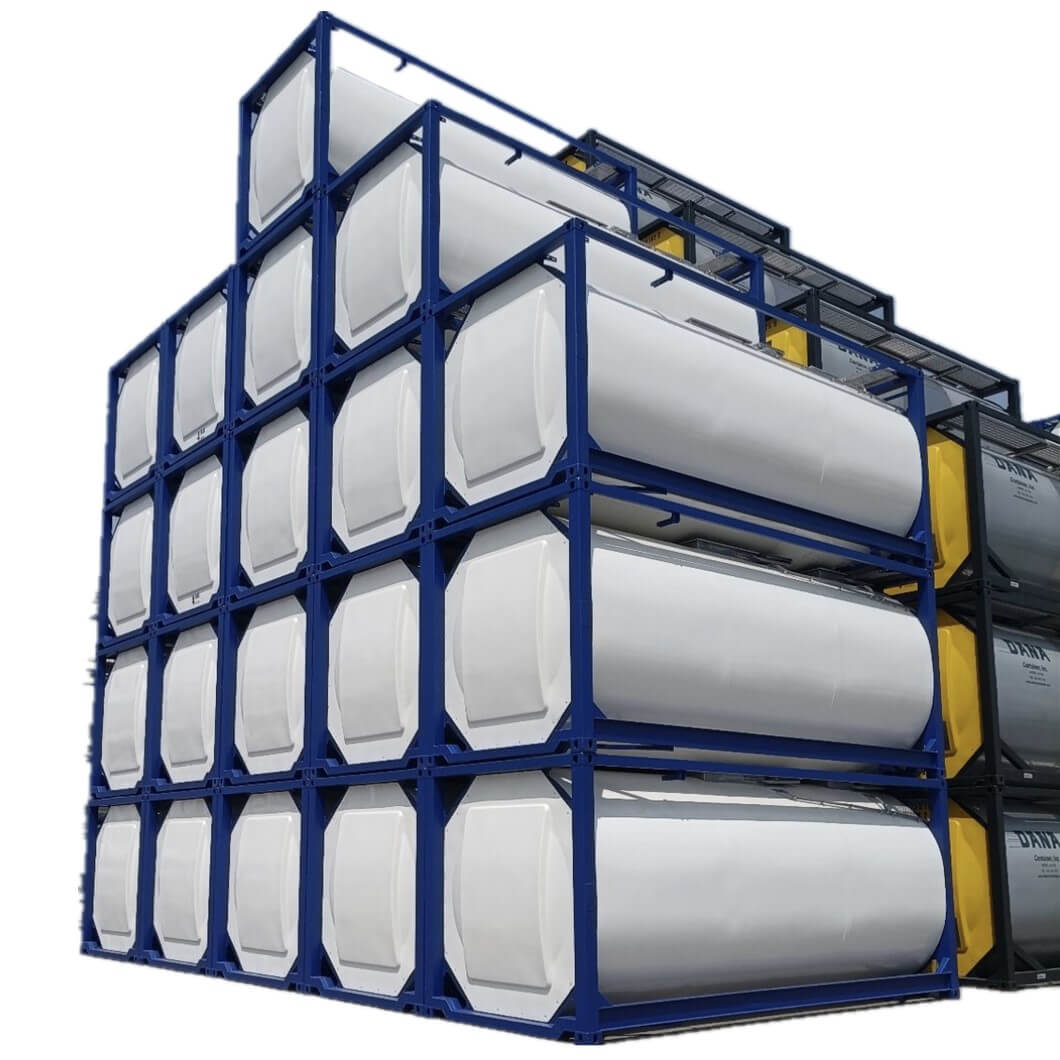
Models such as T21, T50, etc., are used for cross-regional catalyst transportation. They comply with the ISO 6346 international standard, have lifting and stacking capabilities, and are suitable for multimodal transportation including sea and land freight.
3. Mobile Storage UN Portable Tanks (Tank Trucks)
Used for short-distance transportation. The tank body is a pressure vessel, equipped with loading/unloading arm and emergency relief devices, and must comply with the relevant specifications of road dangerous goods transportation.

III. Applicable Catalyst Types
• Ziegler-Natta catalysts (e.g., titanium-based, chromium-based catalysts);
• Metallocene catalysts (highly sensitive to water and oxygen, requiring strict sealing);
• Polymerization-grade cocatalysts (e.g., alkylaluminum compounds, flammable and explosive, requiring explosion-proof design).
IV. International Certification Requirements IMDG
• China: Must obtain the Pressure Vessel Manufacturing License (TS Certification).
• EU: Comply with TPED (Transportable Pressure Equipment Directive) and PED (Pressure Equipment Directive).
• North America: Meet the ASME VIII Pressure Vessel Code and DOT (U.S. Department of Transportation) transportation standards.

3200L 1-Hexene Copolymer & T21 Alpha-Olefin Catalyst UN Portable Tank Technical Specification & Safety Guidelines
1. Overview
This document specifies the technical requirements, safety precautions, and transportation compliance standards for the 3200L UN portable tank used for loading 1-hexene copolymer and T21 alpha-olefin catalyst. The tank is designed in strict accordance with international UN portable tank standards, ensuring the safety and stability of materials during storage and transportation.
2. Core Technical Parameters of the Tank
Parameter Item | Specification Requirement |
Nominal Capacity | 3200L |
Tank Material | 16MnDR/Q345R (GB standard) or SA516 Gr.70 (ASTM standard) ; 316L stainless steel (ensures corrosion resistance, avoids material contamination and catalyst deactivation) |
UN Tank Model | For 1-hexene copolymer: UN T21 (high-temperature liquid transport tank); For T21 catalyst: UN T21 (general-purpose liquid hazardous chemical tank) |
Design Pressure | ≥ 0.4 MPa; Safety valve opening pressure: 0.6 MPa |
Design Temperature Range | -40℃ ~ 120℃ (equipped with electric heating jacket for molten 1-hexene copolymer) |
Sealing Standard | Complies with EN 14432 standard, helium leak rate ≤ 1.6×10⁻⁹ mbar•L/s |
Overall Dimensions (Reference) | 1716×1716×2200 mm (subject to actual design) |
Total Weight (Reference) | 8000 Kg |
3. Safety Precautions for Loading and Unloading
3.1 For 1-Hexene Copolymer
• 1-hexene copolymer is flammable in liquid state and may be in molten state during transportation. The heating jacket temperature should be strictly controlled during loading and unloading to avoid overheating leading to material deterioration
• The tank is equipped with a discharge port with nominal diameter DN50, which should be matched with professional industrial discharge pumps. During unloading, the flow rate should be controlled, and grounding devices should be installed to prevent static accumulation
• Loading and unloading operations should be carried out in a well-ventilated area, away from open flames and heat sources. Explosion-proof ventilation systems and equipment should be used on site
• It is strictly prohibited to mix with oxidants, acids, and food chemicals during loading and unloading to avoid chemical reactions .
3.2 For T21 Alpha-Olefin Catalyst
• The catalyst is sensitive to moisture and light. The tank should be filled with inert nitrogen for protection before loading, and the oxygen content in the tank should be controlled at ≤ 0.5% .
• Loading and unloading personnel should wear professional protective equipment, including chemical safety goggles, anti-static work clothes, and oil-resistant rubber gloves .
• The loading and unloading process should be sealed to avoid the catalyst contacting air and causing deactivation. After loading, the inlet and outlet should be sealed with blind flanges .
• It is forbidden to use mechanical equipment and tools that are prone to generating sparks during loading and unloading to prevent potential safety hazards .
4. Transportation Compliance and Safety Requirements
4.1 International Certification Requirements
• EU Market: Must obtain EC Type Approval Certificate (certificate number format: e.g., 00/000/XXX), marked with CE mark and TPED certification number, and accompanied by tank design calculation report, material certificate, and hydrostatic test report (test pressure = 1.5 times design pressure) .
• North American Market: Complies with DOT 406/412 standards, equipped with DOT standard reflective signs, and provides DOT certification labels and tank inspection certificates (re-inspection every 2 years) .
• Maritime Transportation: Meets IMO Type 1 standards, compatible with 20ft/40ft container dimensions, and provides dangerous goods declaration forms and tank suitability certificates in accordance with IMDG Code requirements .
4.2 Mandatory Marking Requirements
• The top and side of the tank should be clearly marked with UN tank model, capacity (3200L), maximum gross weight, and hazard class (T21 catalyst is Class 9 miscellaneous dangerous goods; 1-hexene copolymer is Class 3 flammable liquid) .
• Medium-specific marks: For T21 catalyst, mark "CATALYST - KEEP DRY" and "Store in Dark Place"; for 1-hexene copolymer, mark "MOLTEN COPOLYMER - HOT SURFACE" and flammable liquid warning signs .
• International universal warning symbols should be pasted, including flammability symbol (for 1-hexene copolymer) and corrosivity symbol (if the catalyst contains corrosive components) .
4.3 Additional Transportation Precautions
• Transport vehicles should be equipped with corresponding fire-fighting equipment and leakage emergency treatment kits (including absorbent cotton, chemical-resistant gloves, and neutralizers) .
• Transportation should be avoided in high-temperature periods in summer; it is recommended to transport in the morning and evening. During transportation, avoid exposure to sunlight and rain, and stay away from fire sources, heat sources, and densely populated areas during stops .
• The tank truck should be equipped with a grounding chain, and a hole baffle can be set in the tank to reduce static electricity generated by vibration .
• Railway transportation is prohibited from being slung; wooden boats and cement boats are strictly prohibited for bulk transportation .
5. Maintenance and Inspection
• Regular inspection should be carried out in accordance with relevant national and international standards, including hydrostatic test (every 2 years) and ultrasonic flaw detection (the qualified grade is not lower than Grade II) <superscript id="91">5.
• After each transportation, the tank should be cleaned and purged. The inner wall should be free of residues and corrosion to avoid cross-contamination between different materials .
• Check the integrity of seals, safety valves, and other accessories regularly. If any damage or leakage is found, repair or replace them in time before use .
All inspection and maintenance records should be retained for no less than 5 years for future reference .
Keystone Vessel Specializing - Industrial Gas Cylinders| ISO Tank| Pressure Vessel| UN Portable Tanks-


